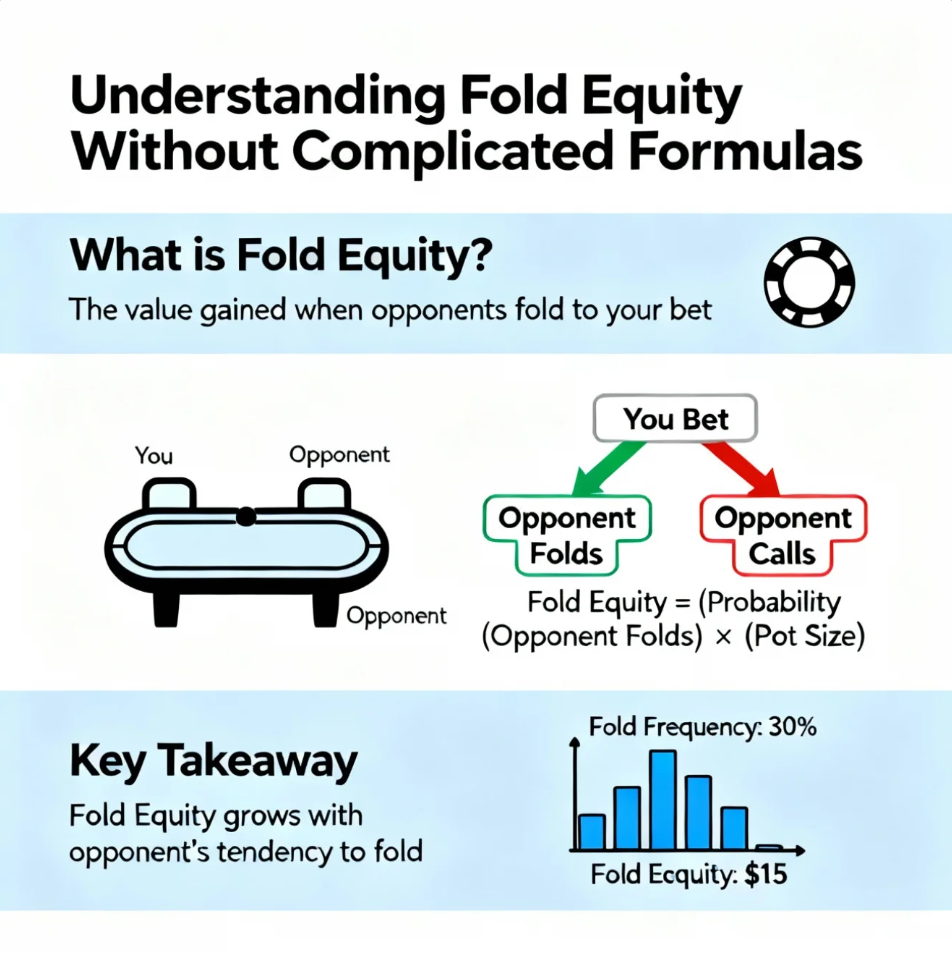

Fold equity is one of the most important concepts in poker—yet many players shy away because it sounds complicated. The good news? You don’t need to memorize complex formulas to use it effectively.
At its core, fold equity is simply the chance your opponent will fold to your bet or raise, giving you a win without a showdown. Understanding it can dramatically improve your decision-making and overall strategy.
What Fold Equity Means in Simple Terms
Imagine you’re in a hand and your opponent is thinking about calling. Fold equity is your opportunity to win the pot by making them fold, rather than having to rely on your cards winning at showdown.
In simple terms:
- Higher fold equity = more likely your bet will make opponents fold
- Lower fold equity = less chance they’ll give up the hand
By thinking about fold equity, you can make smarter bets that maximize profits even when your hand isn’t the strongest.
Factors That Affect Fold Equity
Fold equity isn’t random—it depends on a few key factors:
- Opponent Type
- Tight players fold more often
- Loose players call more frequently
- Position at the Table
- Being last to act increases fold equity
- Acting early usually reduces it
- Bet Size
- Larger bets increase pressure and fold equity
- Smaller bets are less intimidating
- Board Texture
- Scary boards (flush or straight possibilities) increase fold equity
- Dry boards give opponents fewer reasons to fold
Understanding these dynamics helps you estimate fold equity without calculations.
How to Use Fold Equity Effectively
🔹 Semi-Bluffing
Semi-bluffing is when you bet with a hand that may improve on later streets (like a flush or straight draw). Even if you don’t have the best hand yet, fold equity can make opponents fold, letting you win the pot immediately.
🔹 Strategic Aggression
Using fold equity allows you to apply pressure. By reading the table and sizing your bets correctly, you can force folds and protect weaker hands.
🔹 Pot Control
Even when your hand is strong, considering fold equity helps you determine whether a big bet might scare opponents away, or a smaller bet keeps them engaged.
Why Fold Equity Matters More Than Just Card Strength
Many players focus only on their cards—but poker is about reading opponents and creating opportunities. Fold equity transforms your strategy from reactive to proactive, letting you win in ways unrelated to the strength of your hand.
Practical Example (No Math Needed)
- You’re in late position with a moderate hand (like A♣ 9♣)
- Opponent has been playing cautiously
- You make a strong bet and your opponent folds
Result: You win the pot without needing your hand to improve, simply by using fold equity wisely.
Conclusion
Fold equity explained doesn’t need formulas or complicated math. It’s about understanding when your opponents are likely to fold and using that knowledge to make smarter bets.
By combining fold equity with hand reading, position, and bet sizing, you can elevate your poker game and consistently win pots even when your cards aren’t the strongest.