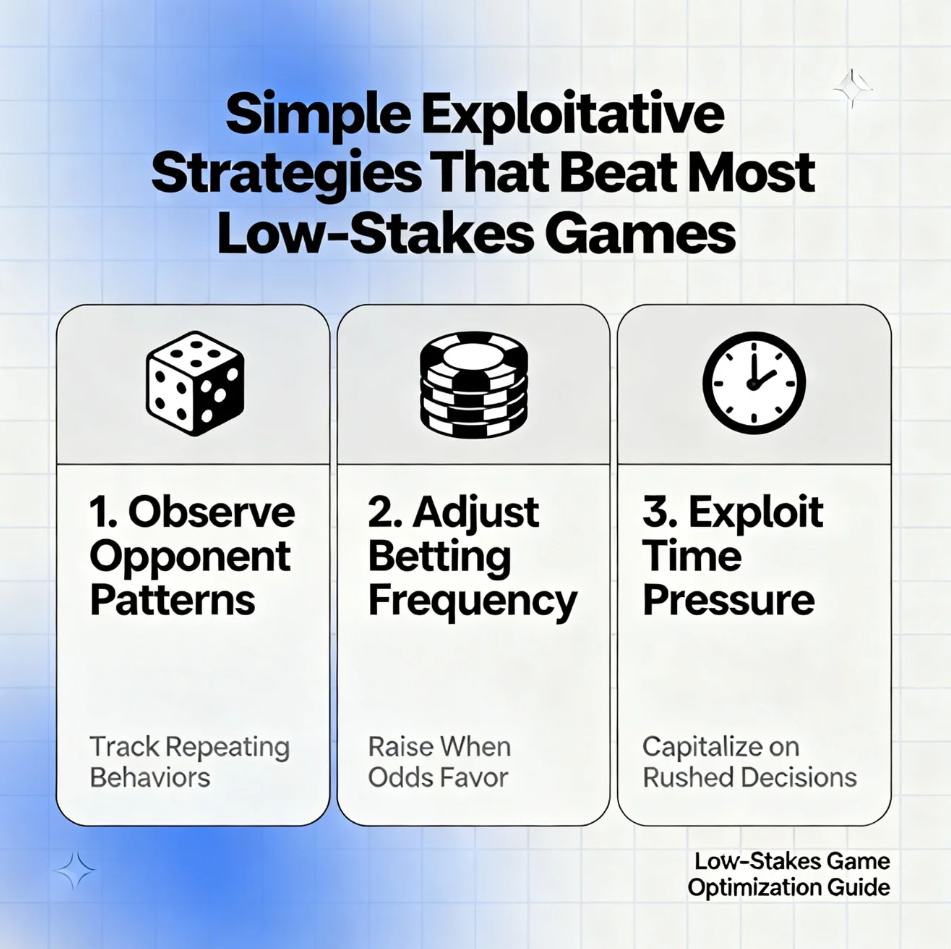

Low‑stakes poker games are full of opportunity—not because they’re complex, but because most players make the same mistakes over and over. While advanced theory and GTO concepts dominate modern poker discussions, the truth is simple: exploitative poker strategies consistently outperform balanced play in low‑stakes environments.
If your goal is to win more—rather than play perfectly—these practical adjustments can dramatically increase your edge.
1. Value Bet Relentlessly (They Call Too Much)
The single biggest leak in low‑stakes games is overcalling. Players hate folding pairs, draws, and even weak top hands.
Exploit:
- Bet bigger with strong hands
- Go for thin value against obvious calling stations
- Stop slow‑playing monsters
If you think, “They might call”, the answer is usually yes—so bet.
2. Bluff Less, But Bluff Smarter
Low‑stakes players love to call, but they also overfold in very specific spots, especially when pressure is applied on later streets.
Exploit:
- Reduce multi‑street bluffs
- Bluff more on scare cards (overcards, completed draws)
- Target tight or straightforward opponents only
You don’t need fancy triple‑barrel bluffs—well‑timed, logical bluffs are enough.
3. Punish Limping With Isolation Raises
Limping is extremely common in low‑stakes games, and it’s almost always weak.
Exploit:
- Raise larger preflop (4–6x + 1x per limper)
- Isolate limpers in position
- Play aggressively post‑flop against capped ranges
Limpers rarely have strong hands, and they often play fit‑or‑fold after the flop.
4. Fold More Against Aggression
While many players call too much, they also don’t bluff enough—especially on the river.
Exploit:
- Give credit to big bets from passive players
- Fold marginal hands more often on the river
- Avoid “curiosity calls” against obvious strength
At low stakes, big river bets are usually value, not bluffs.
5. Bet for Protection (Not Just Value)
Players chase draws incorrectly at low stakes—and they’ll happily call small bets.
Exploit:
- Size bets to deny proper odds
- Charge draws aggressively
- Don’t fear “scaring them off”
Winning poker isn’t about being nice—it’s about making mistakes expensive.
6. Adjust Fast and Exploit Hard
Low‑stakes opponents rarely adjust. When they show you a tendency, believe it.
Exploit:
- If they never fold → value bet wider
- If they never bluff → fold more
- If they play tight → steal relentlessly
You don’t need long histories—patterns appear quickly at these levels.
Why Exploitative Poker Works at Low Stakes
Game‑theory optimal play assumes your opponents are balanced and adaptive. Low‑stakes players are neither. They are emotional, predictable, and habit‑driven.
That’s why exploitative poker strategies—simple, direct, and opponent‑focused—continue to beat low‑stakes games year after year.
Final Thoughts
You don’t need advanced solvers or complex strategies to win at low stakes. You need discipline, observation, and the willingness to exploit obvious mistakes.
Play straightforward. Value bet aggressively. Bluff selectively. Adjust quickly.
That’s how you beat most low‑stakes games—consistently.