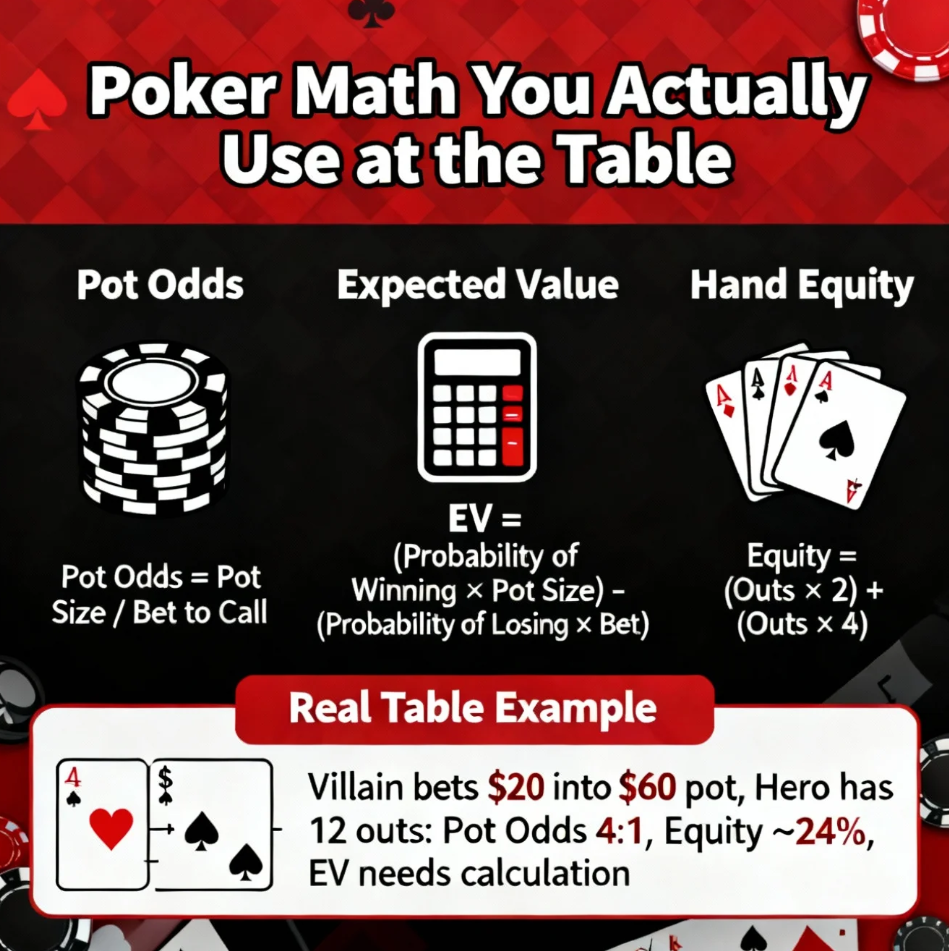

Many poker players fear math at the table—but the truth is, you only need a few key calculations to make smarter decisions and maximize your edge. Understanding poker math at the table isn’t about memorizing complex formulas; it’s about using practical numbers that guide betting, calling, and folding in real time.
Here’s the math you’ll actually use in every session.
🃏 1. Pot Odds: The Core Calculation
Pot odds tell you whether a call is profitable relative to the size of the pot.
How it works:
- Compare the size of the pot to the size of your required call
- Express it as a ratio or percentage
Example:
- Pot = $100, Call = $20 → Pot odds = 100 ÷ 20 = 5:1
- If the chance of hitting your draw is better than 5:1, the call is profitable
Pot odds are the backbone of all decision-making for draws.
🎯 2. Expected Value (EV): Making +EV Decisions
Expected value helps you predict long-term profitability.
Key principle:
- Positive EV (+EV) = profitable play over time
- Negative EV (-EV) = losing play
Example:
- You have a 20% chance to hit a flush
- Pot = $100, Bet = $20
- EV = (0.2 × 100) – (0.8 × 20) = $20 – $16 = +$4
If EV is positive, the play is statistically correct in the long run.
🔢 3. Hand Probabilities: Quick Reference
While you don’t need to memorize every combination, knowing basic probabilities helps:
- Hitting a flush draw after the flop ≈ 35% chance by the river
- Hitting an open-ended straight draw after the flop ≈ 31%
- Pairing one of your hole cards on the flop ≈ 32%
These estimates allow you to make fast, intuitive decisions without a calculator.
🧮 4. Bet Sizing and Implied Odds
Practical poker math isn’t just about calling—it’s about bet sizing and implied odds.
- Bet sizing: Choose bets relative to pot size to protect draws or extract value
- Implied odds: Consider future bets you can win if your draw hits
Example:
- Pot = $50, Opponent bets $25
- You have a draw with potential to win $150 on later streets
- The implied odds justify calling even if raw pot odds are borderline
💡 5. Folding Math: Avoiding Negative EV Traps
Math isn’t only for winning—it’s also for folding when the odds are bad.
- If the probability of winning is lower than the pot odds, folding is the correct choice
- Avoid “hero calls” that feel right emotionally but are -EV
This discipline separates winning players from the rest.
🔮 Final Thoughts: Simplify and Internalize
The poker math you actually use at the table boils down to a few practical concepts:
- Pot odds
- Expected value
- Basic hand probabilities
- Bet sizing and implied odds
Master these, internalize the ratios, and let intuition guide you on the fly. Math becomes second nature, and your decisions become consistently profitable.