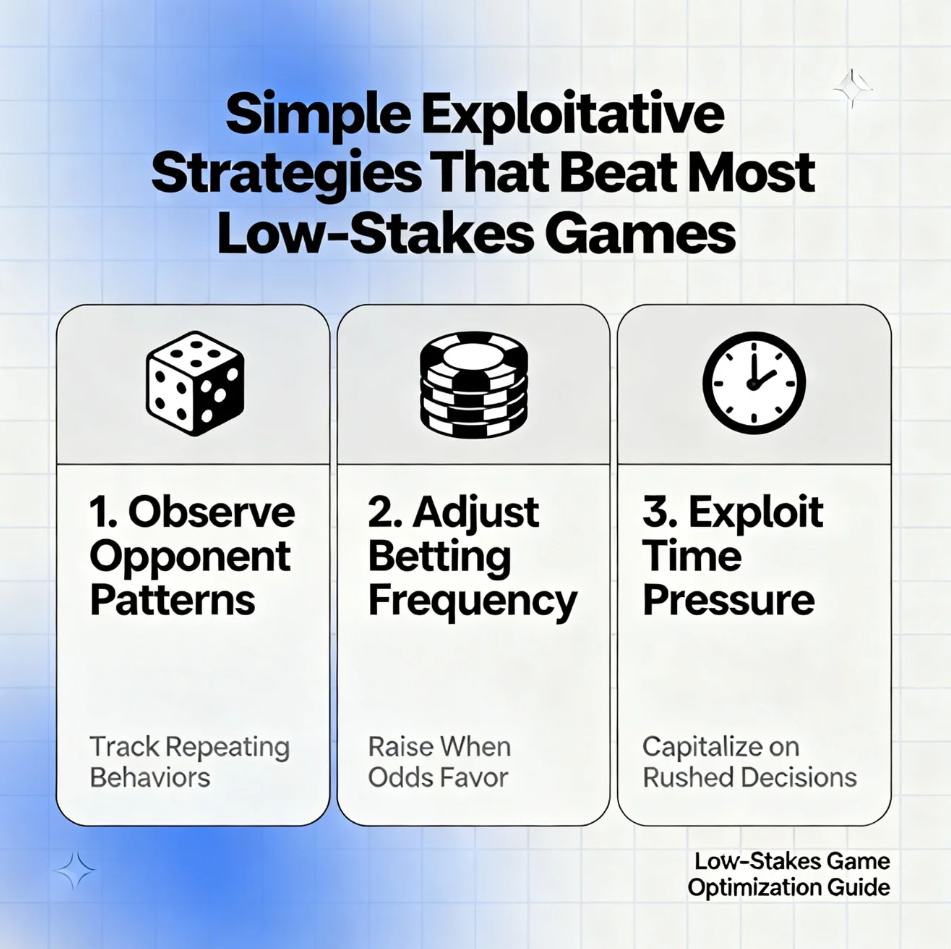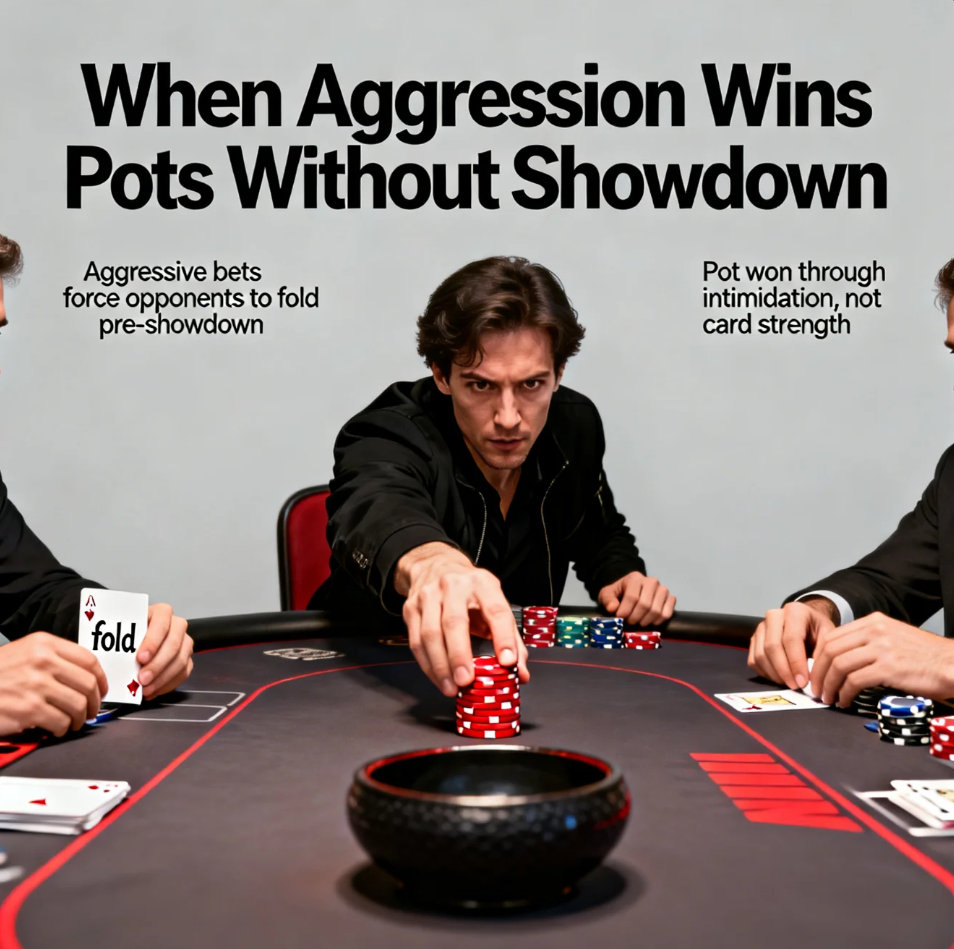
Poker player using aggressive strategy to win pots without showdown

When Aggression Wins Pots Without Showdown

In poker, winning isn’t always about having the best hand at the table. Skilled players know that aggression can secure pots without ever reaching a showdown. By applying strategic pressure, well-timed bets, and calculated raises, you can make opponents fold better hands and claim pots without revealing your cards.

Understanding when and how to use aggression is key to long-term success.


The Psychology of Aggression

Aggression in poker isn’t reckless—it’s strategic. It leverages:

  • Fear: Opponents fold to avoid risk
  • Uncertainty: Strong bets make them question their holdings
  • Perceived dominance: Consistent aggression projects confidence

Players who respect your table image are more likely to fold, giving you pots without contest.


Key Situations to Apply Aggression

  1. Stealing Blinds and Antes
    • Early or late position bets can take small pots uncontested.
    • Aggressive raises pressure tight players to fold marginal hands.
  2. Continuation Bets (C-Bets)
    • After raising pre-flop, a c-bet on the flop maintains initiative.
    • Works especially on dry boards where opponents have missed draws.
  3. Exploiting Passive Opponents
    • Passive players call too often and fold under pressure.
    • Strategic aggression exploits their reluctance to commit chips.
  4. Bluffing with Board Texture in Mind
    • Favorable textures (e.g., low, uncoordinated boards) increase fold probability.
    • Aggression communicates strength and discourages calls.

Position and Aggression

Position amplifies the power of aggression:

  • Acting last lets you observe opponents’ reactions before committing chips.
  • Aggressive plays in late position can steal pots while controlling risk.
  • Early-position aggression requires stronger hands but sets the tone for table dynamics.

Balancing Aggression with Risk Management

Aggression is powerful but must be calibrated. Key considerations:

  • Stack sizes: Avoid overcommitting against deep stacks unnecessarily.
  • Opponent tendencies: Know who will fold versus who will call or raise.
  • Table image: Over-aggression can backfire if opponents adjust.

The goal is profitability, not aggression for its own sake.


Benefits of Winning Without Showdown

  • Conserves chips while minimizing risk
  • Builds table image and psychological leverage
  • Forces opponents to play reactively
  • Increases win rate over the long term

Winning uncontested pots is a cornerstone of modern, winning poker strategy.


Final Thoughts

Aggression in poker is more than betting—it’s a tool to control the table, shape opponents’ decisions, and win pots without revealing your hand. By understanding timing, position, opponent tendencies, and board textures, you can maximize profits while minimizing risk.

In poker, the smartest victories are often the ones your opponents never see coming.

Poker table with cards on the table and a player analyzing opponents across the table

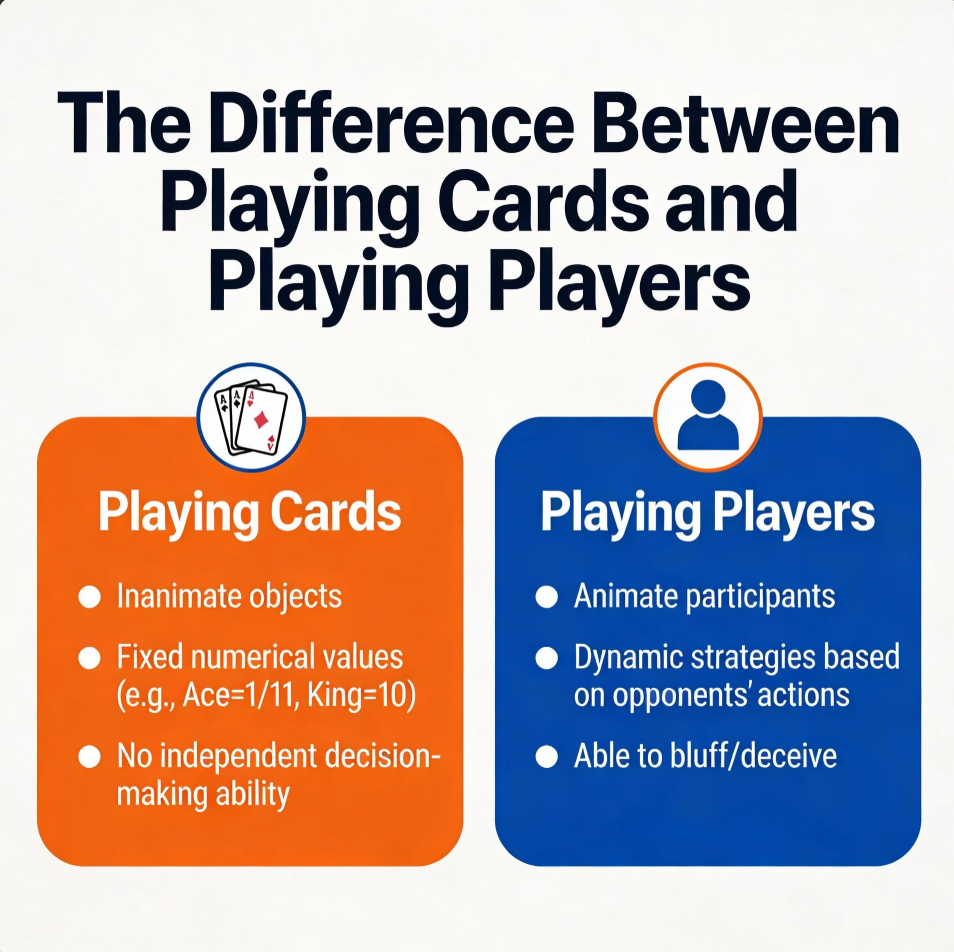
The Difference Between Playing Cards and Playing Players

In poker, winning isn’t just about the hands you hold—it’s about understanding who you’re up against. The distinction between playing cards and playing players is crucial, and mastering it separates casual participants from skilled strategists.

Let’s explore why focusing on the people at the table can be as important as the cards in your hand.


Playing Cards: The Basics

“Playing cards” refers to the straightforward approach of making decisions based solely on the hand you’re dealt.

Key principles include:

  • Understanding hand rankings
  • Calculating odds and probabilities
  • Recognizing potential draws and combinations

This strategy is foundational, but it’s reactive—relying only on what is visible rather than anticipating opponents’ behavior.


Playing Players: The Strategic Edge

“Playing players” takes poker to the next level. Here, success comes from reading opponents, predicting patterns, and leveraging psychology.

Elements of playing players:

  • Observing betting patterns and timing
  • Recognizing tells and behavioral cues
  • Understanding player tendencies (aggressive, passive, tight, loose)
  • Manipulating perception to induce mistakes

Essentially, you play the person more than the cards, turning the game into a mental contest.


Why Players Often Trump Cards

Even the best hand can lose if misplayed against savvy opponents. Conversely, weaker hands can win through strategic play:

  • Bluffing when the table perceives strength
  • Folding strong hands if an opponent shows dominance
  • Adjusting tactics dynamically based on behavior

This highlights that poker is not just a numbers game—it’s a game of human insight and adaptability.


Integrating Both Approaches

Expert players combine both strategies:

  1. Analyze your hand: Know your odds and potential outcomes.
  2. Study your opponents: Gauge tendencies and reactions.
  3. Adjust in real-time: Modify your approach as the table dynamics shift.

Balance between cards and players creates a complete, winning strategy.


Tips for Playing Players Effectively

  • Take notes on opponents’ style and past actions
  • Use position advantage wisely (act after observing others)
  • Vary your own betting patterns to remain unpredictable
  • Stay emotionally neutral—avoid giving away tells

These habits help transform a simple card game into a high-stakes mental exercise.


Final Thoughts: Mind Over Hand

While luck gives you the cards, skill comes from playing the players. Understanding this distinction allows you to maximize every opportunity, control the table, and turn probability into strategy.

In poker, the smartest players know: the game isn’t always about the hand you hold—it’s about the people sitting across from you.

Beginner poker checklist highlighting skills needed before moving up stakes

Beginner Poker Checklist: What to Master Before Moving Up Stakes

Moving up in poker stakes is exciting—but it’s also where many beginners lose hard-earned progress. The difference between micro stakes and higher limits isn’t just money; it’s discipline, decision-making, and consistency.

This beginner poker checklist outlines the core skills every player should master before moving up stakes, helping you avoid costly mistakes and build a solid foundation for long-term success.


1. Solid Understanding of Poker Fundamentals

Before thinking about higher stakes, you must be fluent in the basics.

Fundamentals to Master

  • Hand rankings (automatic, no hesitation)
  • Position and why it matters
  • Pot odds and basic equity concepts
  • Betting actions (check, bet, raise, fold)

If these are not second nature, moving up will expose weaknesses quickly.

👉 Poker basics explained:
PokerStrategy – Poker Fundamentals
https://www.pokerstrategy.com/


2. Bankroll Management Discipline

Poor bankroll management is the #1 reason beginners go broke.

Essential Rules

  • Never risk money you can’t afford to lose
  • Maintain at least 30–50 buy-ins for your stake
  • Move down immediately if bankroll drops
  • Separate poker money from personal finances

Moving up without proper bankroll discipline turns poker into gambling—not strategy.

👉 Bankroll concepts:
Upswing Poker – Bankroll Management Guide
https://upswingpoker.com/


3. Strong Preflop Strategy

Winning poker starts before the flop.

Preflop Skills to Lock In

  • Position-based opening ranges
  • Understanding when not to play hands
  • Avoiding limp-heavy strategies
  • Adjusting ranges by table dynamics

If you’re guessing preflop, you’re not ready to move up.


4. Postflop Decision-Making

Higher stakes punish passive and unclear postflop play.

Postflop Concepts to Master

  • Continuation betting fundamentals
  • Value betting vs bluffing
  • Understanding board textures
  • Knowing when to fold strong hands

If you consistently reach showdowns unsure of your decisions, pause your progression.


5. Ability to Read Player Tendencies

You don’t need psychic skills—but you need observation.

What to Look For

  • Who plays too many hands
  • Who folds too often
  • Who over-bluffs or under-bluffs
  • Betting patterns and timing tells

Beginner games are full of predictable players—learning to exploit them is essential before moving up.


6. Emotional Control and Tilt Management

Higher stakes amplify emotions.

Signs You’re Ready

  • You don’t chase losses
  • You quit sessions when tilted
  • Bad beats don’t affect your next decisions
  • You focus on decision quality, not outcomes

If tilt controls your play, stakes will control your bankroll.

👉 Mental game insight:
The Poker Mindset – Jared Tendler
https://jaredtendler.com/


7. Consistent Winning Sample Size

One good week doesn’t mean you’re ready.

Minimum Proof of Readiness

  • 20,000–50,000 hands played
  • Clear long-term win rate
  • Comfortable decision-making speed
  • Confidence without overconfidence

Consistency matters more than short-term success.


8. Basic Hand Review Habits

Winning players review. Losing players guess.

Review Checklist

  • Mark hands during play
  • Analyze tough spots after sessions
  • Understand why you lost or won pots
  • Identify recurring mistakes

You don’t need advanced solvers yet—but you must reflect.


9. Understanding Variance

Poker involves swings—even when played perfectly.

What Beginners Must Accept

  • Downswings are inevitable
  • Short-term results don’t define skill
  • Good decisions can lose money
  • Bad players sometimes win

If variance frustrates you, higher stakes will magnify that frustration.


10. Clear Reason for Moving Up

Never move up out of boredom or ego.

Good Reasons to Move Up

  • Bankroll supports it
  • Win rate is stable
  • Decision-making feels comfortable
  • Emotional control is proven

Bad reasons include chasing losses, impatience, or copying others.


Final Beginner Poker Checklist

Before moving up stakes, ask yourself:

✔ I understand fundamentals effortlessly
✔ I follow strict bankroll rules
✔ My preflop and postflop play is intentional
✔ I control tilt and emotions
✔ I win consistently over a large sample
✔ I review and improve my play

If any box is unchecked—stay where you are.


Conclusion

Moving up stakes is not a reward—it’s a responsibility. This beginner poker checklist helps ensure you move forward with preparation instead of pressure.

Poker rewards patience, discipline, and clarity. Master those first, and the stakes will take care of themselves.

poker flow step by step from dealing cards to winning chips

From Cards to Chips: Understanding Poker Flow Step by Step

Poker can look intimidating at first—chips moving fast, players acting in turn, and unfamiliar terms flying around the table. But once you understand the poker flow step by step, the game becomes far more enjoyable. Poker is simply a repeating cycle of cards, bets, and decisions.

This guide walks you through that cycle clearly, from the first card dealt to the final chips pushed to the winner.


Step 1: The Dealer Button and Positions

Before any cards are dealt, poker establishes who acts when.

The Dealer Button

A round marker (the “button”) shows the dealer position. In home games, the person on the button often deals. In casinos, a professional dealer handles the cards, but the button still rotates each hand.

Why Position Matters

Poker is played in a circle, and players act clockwise. Acting later in the hand gives you more information—one of the most important advantages in poker.


Step 2: Blinds or Antes Are Posted

To create action, most poker games require forced bets.

In Texas Hold’em and Omaha:

  • Small Blind (SB): posted by the player left of the button
  • Big Blind (BB): posted by the next player left

Some games also include antes, small forced bets posted by everyone. These forced bets ensure there is always something to win.

👉 If you want a deeper explanation of blinds and betting rules, see:
https://www.pokernews.com


Step 3: Cards Are Dealt

Now the hand begins.

Texas Hold’em:

  • Each player gets 2 private cards (hole cards)

Omaha:

  • Each player gets 4 private cards (hole cards)

The dealer then prepares for the first betting round.


Step 4: Pre-Flop Betting Round

This is the first decision point and a major part of poker flow step by step.

Starting with the player left of the big blind, each player chooses one action:

  • Fold: discard the hand and exit the round
  • Call: match the current bet
  • Raise: increase the bet

Action continues until all remaining players have matched the highest bet or folded.


Step 5: The Flop (Community Cards)

After pre-flop betting ends, the dealer places 3 community cards face-up on the table. This is called the flop.

These cards are shared by all players to make the best possible hand (using their hole cards plus community cards).


Step 6: Post-Flop Betting Round

Now betting starts again, usually with the player left of the dealer button still in the hand.

Players can:

  • Check: pass the action without betting (only if no bet has been made)
  • Bet: place the first bet in that round
  • Call, Raise, or Fold depending on what happens before them

This round continues until all active players have responded.


Step 7: The Turn

Next, the dealer places the 4th community card, known as the turn.

This card often changes hand strength significantly, which is why the turn is a key betting street in strategy.


Step 8: Turn Betting Round

Another betting round follows with the same flow:

  • Check or bet
  • Call, raise, or fold
  • Continue until the betting is balanced

Step 9: The River

The dealer reveals the 5th and final community card, called the river.

By now, every player has access to:

  • Their private cards
  • All five community cards

This is the last chance to bet, bluff, or extract value.


Step 10: Final Betting Round

The last betting round happens after the river.

Players decide whether to:

  • Bet for value
  • Bluff
  • Check and see a showdown
  • Fold if facing a bet they can’t justify calling

Step 11: Showdown (If More Than One Player Remains)

If at least two players are still in after the final betting round:

  • Players reveal their hands
  • The best 5-card poker hand wins

If everyone folds to a bet earlier, the last remaining player wins without showing cards.

👉 For official hand rankings, you can reference:
https://www.wsop.com/poker-hands/


Step 12: Chips Are Awarded and the Button Moves

The dealer pushes the pot to the winner, and then:

  • The dealer button moves one seat clockwise
  • New blinds are posted
  • A new hand begins

That’s the full poker cycle—repeat it, and you’re officially following poker flow like a pro.


Quick Recap: Poker Flow Step by Step

  1. Button & positions set
  2. Blinds/antes posted
  3. Cards dealt
  4. Pre-flop betting
  5. Flop
  6. Betting
  7. Turn
  8. Betting
  9. River
  10. Betting
  11. Showdown
  12. Pot awarded, button moves

Final Thoughts

Once you understand poker flow step by step, poker becomes a game of rhythm: information, decisions, and pressure across the betting streets. Whether you’re playing casually with friends or watching tournaments online, knowing the structure makes everything easier to follow—and far more fun.

Poker Rules Every New Player Gets Wrong

Poker Rules Every New Player Gets Wrong

Poker looks simple on the surface, but many beginners lose chips not because of bad luck—but because they misunderstand basic rules. These small mistakes can quickly turn a fun game into an expensive lesson.

In this guide, we break down the poker rules new players get wrong most often, so you can play with confidence and avoid common traps at the table.


🃏 1. Misunderstanding Hand Rankings

One of the most common poker mistakes is confusing hand strength. New players often overvalue hands like:

  • Two pair
  • Low straights
  • Weak flushes

For example, a straight always beats three of a kind—but many beginners get this wrong in live games.

Tip: Memorize hand rankings before playing real money games.


♠️ 2. Thinking the Dealer Always Wins Ties

In poker, ties are split pots—the dealer does not automatically win.

If two players have identical winning hands:

  • The pot is divided evenly
  • Suits do not break ties in standard poker

This rule surprises many new players coming from casual home games.


💰 3. Confusing Betting Rounds

New players often misunderstand when betting ends. In games like Texas Hold’em:

  • Each betting round continues until all active players have matched the highest bet
  • Checking is only allowed if no one has bet
  • Calling does not end the round if another player raises

Misunderstanding this rule can lead to accidental folds or illegal bets.


🔄 4. Believing You Must Show Your Cards

At showdown, you are not required to show your cards if you don’t want to—unless your hand is needed to determine the winner.

If you know you’ve lost:

  • You can muck your hand
  • No obligation to reveal your cards

Many beginners expose their hands unnecessarily, giving opponents free information.


🪙 5. Thinking Chips Equal Cash Value at All Times

Poker chips only represent money within the context of the game. Their value depends on the table stakes.

Common mistake:

  • Assuming chips from one game can be used in another
  • Forgetting chip denominations

Always confirm chip values before playing.


🎯 6. Misunderstanding the Role of Position

Position is not a “soft rule”—it’s fundamental. Acting later in a betting round gives you more information, which is a major advantage.

New players often:

  • Play too many hands from early position
  • Ignore positional strategy

While not a written rule, position strongly influences winning decisions.


🚫 7. Thinking Verbal Declarations Don’t Count

In live poker, verbal actions are binding.

If you say:

  • “Call” → you must call
  • “Raise” → you must raise

Many beginners think only chips matter—but spoken intent is enforceable.


🧠 8. Assuming Poker Is Just About the Cards

Poker is a game of rules, psychology, and strategy. Beginners often overlook:

  • Betting patterns
  • Table etiquette
  • Player behavior

Understanding the rules is the first step toward reading opponents and making better decisions.


✅ Why Learning Poker Rules Matters

Mastering the poker rules new players get wrong helps you:

  • Avoid embarrassing mistakes
  • Protect your bankroll
  • Play confidently in live and online games

The best players don’t just rely on luck—they rely on knowledge.

Poker players observing the table before playing a hand

How to Read the Poker Table Before You Play a Single Hand

Great poker players don’t rush into action. Before chips are ever pushed into the pot, they take time to read the poker table—observing players, patterns, and dynamics that reveal valuable information.

Whether you’re playing live or online, the minutes before your first hand can give you a powerful edge.


Why Reading the Poker Table Matters

Poker isn’t just about cards—it’s about people.

By reading the table early, you can:

  • Identify weak and strong players
  • Adjust your strategy before committing chips
  • Avoid costly early mistakes
  • Spot profitable opportunities

According to PokerStrategy, early observation is one of the most overlooked skills among recreational players:
https://www.pokerstrategy.com/strategy/


Observe Player Types Before Playing

One of the fastest ways to read a poker table is to classify player styles.

Common player types include:

  • Tight players – Play few hands, usually strong
  • Loose players – Play many hands, often weak
  • Aggressive players – Bet and raise frequently
  • Passive players – Call more than they bet

Spotting these tendencies early helps you decide who to avoid and who to target.


Watch Betting Patterns Closely

Even without seeing cards, betting behavior tells a story.

Look for:

  • Players who raise every hand
  • Players who only bet when checked to
  • Sudden changes in bet sizing
  • Hesitation or snap decisions

As Upswing Poker explains, betting patterns often reveal more than physical tells:
https://upswingpoker.com/poker-betting-patterns/


Pay Attention to Stack Sizes

Chip stacks influence how players behave.

Before playing, note:

  • Short stacks who may shove aggressively
  • Deep stacks who can apply pressure
  • Players protecting medium stacks cautiously

Understanding stack dynamics helps you predict risk tolerance and future moves.


Study Table Flow and Energy

Every table has a rhythm.

Ask yourself:

  • Is the table aggressive or passive?
  • Are pots small or frequently large?
  • Is there a dominant player controlling action?

Matching—or countering—the table’s energy can significantly improve your results.


Read Physical and Timing Tells (Live & Online)

In live poker, physical tells can be revealing:

  • Nervous movements
  • Avoiding eye contact
  • Overacting confidence

Online, timing tells matter:

  • Instant bets vs delayed actions
  • Consistent response patterns

According to CardPlayer, timing tells are especially valuable in online games:
https://www.cardplayer.com/poker-strategy


Take Notes Without Playing

One of the smartest moves is not playing at all—yet.

Use the first orbit to:

  • Track showdowns
  • Note how players react to wins and losses
  • Identify emotional or tilted players

Patience before participation often leads to stronger decisions later.


Adjust Your Strategy Before the First Hand

Once you’ve read the table, adjust accordingly:

  • Tighten up at aggressive tables
  • Loosen up against passive players
  • Target predictable opponents
  • Avoid unnecessary early confrontations

This preparation allows you to enter your first hand with context, not guesswork.


Why the Best Hands Are Played Before Cards Are Dealt

Poker rewards awareness. The best players gain their edge not from luck, but from information gathered before the action begins.

By learning how to read the poker table before you play a single hand, you:

  • Reduce variance
  • Increase confidence
  • Improve long-term results

Sometimes, the smartest move is simply watching—and learning.

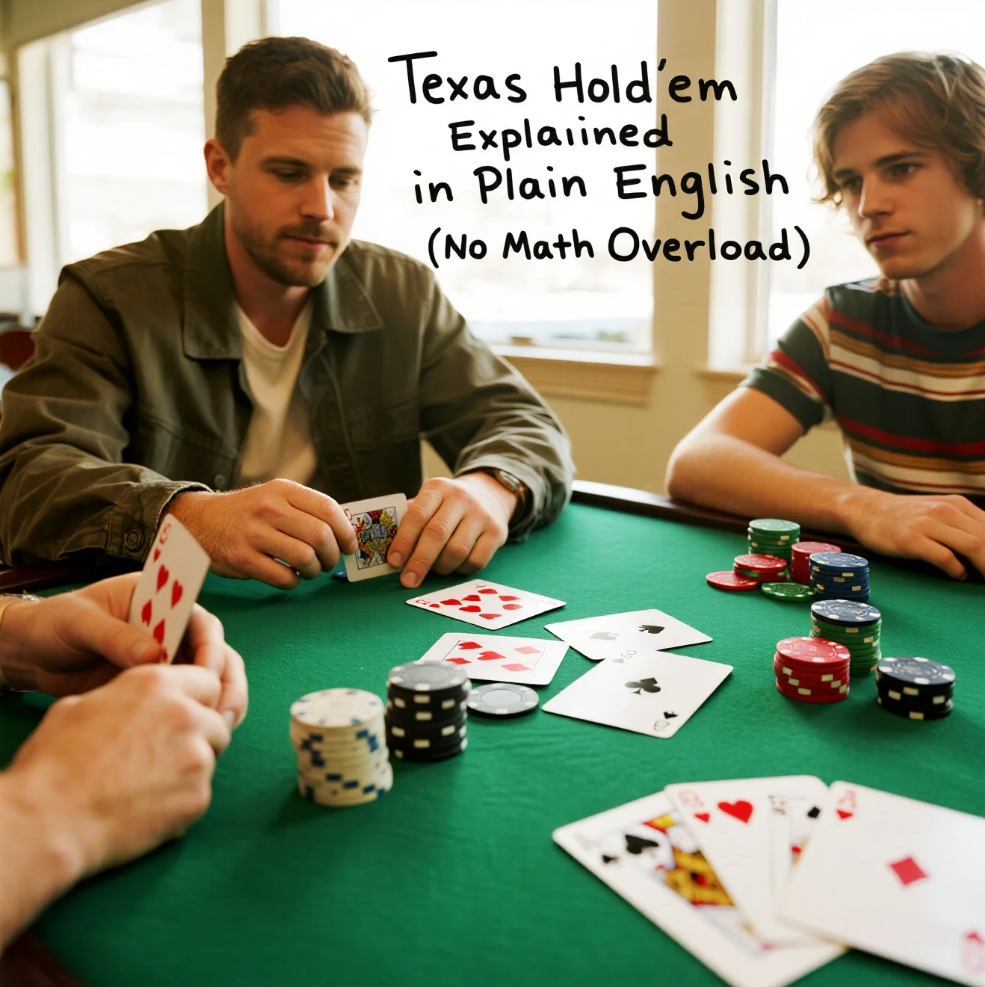
Texas Hold’em Explained in Plain English (No Math Overload)

Texas Hold’em Explained in Plain English (No Math Overload)

Texas Hold’em has a reputation for being complicated—full of odds, probabilities, and intimidating poker faces.

Good news: you don’t need math to understand Texas Hold’em.

At its core, it’s a simple game of decisions, observation, and timing. This guide explains Texas Hold’em in plain English—so you can understand the game, follow along at a table, and enjoy playing without stress.


What Is Texas Hold’em? (The One-Sentence Version)

Texas Hold’em is a card game where you try to make the best 5-card hand using your two cards plus five shared cards.

That’s it. Everything else builds on that idea.


What You’re Given at the Start

Each player gets:

  • 2 private cards (only you can see them)

Then the dealer places:

  • 5 community cards face-up on the table (everyone uses these)

You combine any 5 cards total (your 2 + the table cards) to make your best hand.


The Goal of the Game

You win a hand in one of two ways:

  1. You have the best hand at the end, or
  2. Everyone else gives up (folds) before the end

You don’t need the best cards—just the best decision.


The Flow of a Texas Hold’em Hand (Step by Step)

1. The Deal

Everyone gets two cards.

If you like them, you stay in.
If you don’t, you can fold (quit that hand).


2. The Flop

Three community cards are placed on the table.

Now you start to see what kind of hand might be forming.


3. The Turn

A fourth community card is added.

Hands get clearer. Decisions matter more.


4. The River

The fifth and final community card appears.

This is your last chance to bet or fold.


5. The Showdown

Anyone still in the hand shows their cards.
Best 5-card hand wins the pot.


Poker Hands (Only What You Need to Know)

You don’t need to memorize everything right away. Start here:

From strongest to weakest (simplified):

  • Straight Flush – Five cards in order, same suit
  • Four of a Kind – Four matching cards
  • Full House – Three of one kind + two of another
  • Flush – Five cards, same suit
  • Straight – Five cards in order
  • Three of a Kind – Three matching cards
  • Two Pair – Two different pairs
  • One Pair – One matching pair
  • High Card – None of the above

👉 Tip: Most hands are won with pairs or two pairs, not fancy combinations.


What You Can Do on Your Turn

You always have simple choices:

  • Check – Pass (if no one has bet)
  • Call – Match someone else’s bet
  • Raise – Increase the bet
  • Fold – Quit the hand

No math required—just comfort and confidence.


The Big Beginner Secret: It’s Not About Cards Alone

New players think:

“I need good cards to win.”

Experienced players know:

“I need good timing.”

Texas Hold’em is about:

  • Watching opponents
  • Knowing when to stay in
  • Knowing when to walk away
  • Not playing every hand

Folding is not losing—it’s smart poker.


Common Beginner Mistakes (Avoid These)

  • ❌ Playing every hand
  • ❌ Staying in just because you’re curious
  • ❌ Chasing unlikely cards
  • ❌ Forgetting position (acting later is better)

According to PokerNews, most beginner losses come from playing too many hands—not bad luck.
👉 https://www.pokernews.com


Why Texas Hold’em Is So Popular

Texas Hold’em dominates poker because it’s:

  • Easy to learn
  • Hard to master
  • Social and strategic
  • Playable casually or competitively

As Britannica notes, its balance of simplicity and depth is why it became the world’s most played poker variant.
👉 https://www.britannica.com


Plain-English Strategy for Beginners

Keep it simple:

  • Play fewer hands
  • Fold early if unsure
  • Bet when confident
  • Watch more than you act
  • Don’t chase losses

You’ll improve faster by playing calmly, not aggressively.


Conclusion: You Already Understand Texas Hold’em

Texas Hold’em isn’t a math test.
It’s a game of choices, patience, and people.

If you remember just three things:

  1. Use your two cards + the table
  2. Fold more than you play
  3. You don’t need perfect cards to win

—you’re already ahead of most beginners.

That’s Texas Hold’em, explained in plain English.

Poker beginner learning Texas Hold’em basics with cards, chips, and hand ranking chart

Poker for Absolute Beginners: What to Learn in Your First 30 Days

Poker can look intimidating at first—chips flying, strange terms, and players who seem to know exactly what they’re doing. The good news? Poker is a skill-based game that anyone can learn step by step.

This guide to poker for absolute beginners breaks down exactly what to focus on in your first 30 days, so you build confidence, avoid common mistakes, and learn the game the right way—without overwhelm.


🗓️ Week 1: Learn the Absolute Basics

🃏 Understand Poker Hand Rankings

Before anything else, you must memorize hand rankings. This is non-negotiable.

From strongest to weakest:

  • Royal Flush
  • Straight Flush
  • Four of a Kind
  • Full House
  • Flush
  • Straight
  • Three of a Kind
  • Two Pair
  • One Pair
  • High Card

📖 Official hand ranking guide:
https://www.pokernews.com/poker-hands.htm


🎯 Learn the Rules of One Game (Texas Hold’em)

Texas Hold’em is the best starting point for beginners because:

  • It’s the most popular format
  • Rules are straightforward
  • Free learning resources are everywhere

Focus on:

  • Blinds (small blind & big blind)
  • Community cards
  • Betting rounds (pre-flop, flop, turn, river)

🔗 Texas Hold’em rules:
https://www.pokerstars.com/poker/games/texas-holdem/


🗓️ Week 2: Basic Strategy & Smart Habits

🧠 Play Fewer Hands (But Play Them Well)

One of the biggest beginner mistakes is playing too many hands.

Early rule:

  • Play strong hands
  • Fold weak hands
  • Don’t chase every pot

This single habit will instantly improve your results.


💰 Learn Basic Poker Position

Position means where you sit relative to the dealer button.

Key idea:

  • Acting later = more information
  • Acting early = higher risk

Beginner tip:
👉 Play tighter (more carefully) in early position, looser in late position.

📌 Poker position explained:
https://upswingpoker.com/poker-position-guide/


🗓️ Week 3: Betting, Odds & Reading the Table

📊 Understand Basic Betting Concepts

You don’t need advanced math yet. Start with:

  • When to bet vs. check
  • Why small bets can be strong
  • Why big bets usually mean commitment

Avoid bluffing too much early—solid value betting beats fancy moves.


👀 Start Observing Opponents

Poker is a people game.

Begin noticing:

  • Who plays too many hands
  • Who bets aggressively
  • Who folds easily

You don’t need perfect reads—just patterns.


🗓️ Week 4: Practice, Review & Discipline

🎮 Play Low Stakes or Free Games

Your first 30 days should focus on:

  • Free poker apps
  • Play-money games
  • Very low-stakes tables

The goal is learning, not winning big.


🧾 Review Your Hands

After sessions, ask:

  • Did I play strong hands correctly?
  • Did I fold when I should have?
  • Did emotions affect my decisions?

Self-review accelerates improvement faster than playing more hours.


🚫 Common Beginner Mistakes to Avoid

  • Playing too many hands
  • Chasing losses
  • Bluffing without a reason
  • Ignoring position
  • Playing while emotional or tired

Poker rewards patience—not impulse.


🧩 What You Should NOT Learn Yet

In your first 30 days, avoid:

  • Advanced bluffing strategies
  • Complex poker math
  • Multi-table grinding
  • High-stakes games

Strong fundamentals beat advanced tricks every time.


✅ Final Thoughts

Poker is not about luck in the long run—it’s about decision-making.

If you focus on:

  • Hand rankings
  • Position
  • Discipline
  • Smart practice

your first 30 days will build a solid foundation that most players never develop.

Master the basics first.
The wins come later.